

Table of Contents
- Step 1: Gather the Right Cleaning Supplies
- Step 2: Remove Surface Dust and Loose Debris
- Step 3: Tackle Adhesive and Sticker Residue
- Step 4: How to Remove Scratches from PSA Cases
- Step 5: Buff Out Haze and Cloudiness
- Step 6: Best Plastic Polish for Card Slabs
- Step 7: Graded Card Storage Best Practices
- Conclusion: Protect Your Investment with Proper Care
- Frequently Asked Questions
Last Updated: September 18, 2026
Step 1: Gather the Right Cleaning Supplies
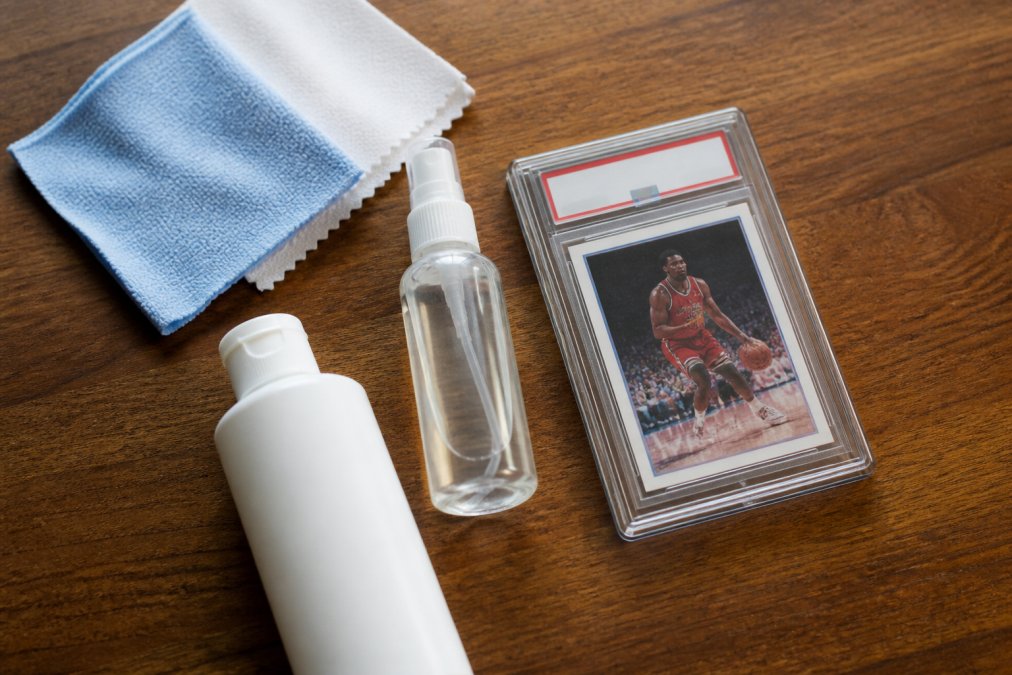
Collect these before you touch a single case:
- Two or three microfiber cloths (lint-free, clean, no fabric softener)
- A small spray bottle of distilled water (tap water leaves mineral spots)
- Isopropyl alcohol at 70% strength for sticky residue
- A mild plastic polish or polishing compound
- Cotton swabs for tight corners
- A soft camera lens brush or blower
Step 2: Remove Surface Dust and Loose Debris
Dust is the first enemy, and it is the easiest to beat. Skip this step and you grind grit into the plastic when you polish.
Step 3: Tackle Adhesive and Sticker Residue
Price stickers and tape leave adhesive that traps dirt and looks worse over time. Removing it takes patience, not muscle.
Here is the safe method:
- Dampen a microfiber cloth with 70% isopropyl alcohol.
- Hold the cloth against the residue for 10-15 seconds to soften it.
- Wipe in one direction with light pressure.
- Repeat until the sticker lifts cleanly.
Step 4: How to Remove Scratches from PSA Cases
Learning how to remove scratches from PSA cases means matching the fix to the depth of the damage and to the plastic the case is actually made of. Light scuffs sit on the surface. Deep gouges do not come out, and no amount of polish will change that.
Sort the damage before you touch it
Use a bright, angled light source, a desk lamp or a phone flashlight held at a low angle, and tilt the slab until the scratch catches the beam. Then classify:
- Surface swirls: faint lines that disappear when you change the viewing angle. You cannot feel them with a fingernail. These are buffable.
- Scuff marks: dull, hazy patches where the slab rubbed against another slab or a box. No single line, just a loss of gloss. Buffable.
- Shallow scratches: a line you can feel with a fingernail but that does not catch the nail edge. Usually buffable with patience.
- Deep gouges: a cut that catches a fingernail edge or that you can see from the side profile. Not repairable. Polishing a gouge only widens the trench and spreads haze around it.
- Structural cracks: any crack that runs toward the seam or the label. Stop. Do not clean, do not polish. This is a re-slab case.
Match the method to the plastic
Most graded slabs are one of two plastics, and they behave differently under abrasion:
- Acrylic (the clear, rigid, glass-like plastic used by most major grading companies) polishes to a high gloss but is brittle. It scratches easily and can craze, develop fine internal cracks, if you apply too much heat from fast rubbing.
- Polycarbonate is softer and more impact-resistant but hazes faster. It responds well to mild polish but is more prone to swirl marks if you use a coarse compound.
Buffing mechanics that actually work
- Clean the slab first. Polishing over dust grinds grit into the surface.
- Apply a pea-sized amount of mild plastic polish to a clean microfiber cloth, never directly to the slab.
- Work a 1-inch square area at a time. Small circles, light pressure, about 20 to 30 seconds per area.
- Stop and wipe with a second clean cloth. Check under the angled light before continuing.
- Move to a finer compound only if the first pass left visible swirl. Do not jump straight to aggressive grit.
Heat is the enemy. If the plastic feels warm to the touch, stop and let it cool. Fast rubbing on acrylic can warp a thin slab or cloud the area you were trying to fix.
When to stop and re-slab
Re-slabbing is the right call when:
- The scratch is a deep gouge or structural crack
- The haze is chemical etching from a harsh cleaner and does not lift with fine polish
- The label or seam shows any sign of moisture damage
- The slab has yellowed with age, polishing cannot reverse yellowing
Most grading companies offer a re-holder service, and for a card with meaningful value, a fresh holder is almost always cheaper than the risk of damaging the card inside. Polishing a compromised slab is how collectors turn a minor cosmetic issue into a permanent one.
Step 5: Buff Out Haze and Cloudiness
Haze and cloudiness come from two sources: chemical damage or micro-abrasion. The fix depends on which one you have.
Here is how to tell the difference:
| Problem | Cause | Fix |
|---|---|---|
| Faint lines | Surface scratches | Mild polish, light buffing |
| Dull patches | Scuff marks | Polishing compound |
| White cloudiness | Chemical damage | Fine polish or re-slab |
| Deep cuts | Impact damage | Re-slab the card |
Step 6: Best Plastic Polish for Card Slabs
The best plastic polish for card slabs is a mild, non-abrasive compound formulated for clear acrylic and polycarbonate. Skip anything with grit meant for metal, car paint, or headlight restoration, those cut too aggressively and leave permanent swirl on a slab.
What to look for on the label
- Non-abrasive or fine-grade formula safe for clear plastics
- No ammonia, acetone, methyl ethyl ketone (MEK), or chlorinated solvents
- Labeled for acrylic or polycarbonate
- Water-based or petroleum-free where possible, easier to wipe clean and less likely to leave residue in the seam
Ingredient warnings most guides skip
This is the part competitors miss. The same chemical can be safe on one plastic and destructive on another:
- Isopropyl alcohol at 70% is generally safe for spot-cleaning acrylic and polycarbonate, but higher concentrations and repeated use can dull the surface over time. Use it for residue, not for routine polishing.
- Ammonia-based cleaners (common in glass sprays) attack acrylic and cause fine crazing, a network of tiny internal cracks that looks like haze and cannot be polished out.
- Acetone, MEK, and lacquer thinner will melt or cloud most slab plastics on contact. There is no safe dilution for these on a graded card slab.
- Petroleum distillates in some automotive polishes can soften polycarbonate and leave a greasy film that traps dust.
Application that protects the card inside
The card is the real concern. Any liquid you apply near the seam can wick into the seal and reach the card or the label. That is why the method matters as much as the product:
- Apply polish to the cloth, never the slab.
- Keep the cloth at least a quarter inch away from the seam and label edge.
- Work the center of the face first, then move outward, never start at the edge.
- Wipe residue with a second clean, dry microfiber cloth.
- Finish with a dry buffing pass to remove streaks.
Trade-offs to know
- More product does not mean more shine. Past two or three light passes, you are just adding swirl marks.
- Coarser compounds cut faster but leave haze. Always finish with a finer grade.
- Some polishes leave a silicone or wax residue that looks great for a day and then attracts dust. Water-based formulas are easier to keep clean long-term.
- Polishing removes a microscopic layer of plastic. Every polish session thins the surface slightly. That is why prevention and storage matter more than repeated cleaning.
Once the surface is clean, the real protection starts. PrismGuard Pro cases use impact-resistant materials to shield graded cards from the scratches and surface wear that cleaning can only fix after the fact.
Step 7: Graded Card Storage Best Practices
Good graded card storage best practices prevent most of the damage you just learned to fix. Prevention beats restoration every time.
Follow these rules:
- Store slabs upright in acid-free boxes or protective cases
- Keep cards out of direct sunlight to reduce fading
- Avoid humid rooms, basements, and attics (Storing Your Books - Preserving Your Books)
- Handle slabs by the edges, never the face
- Keep slabs from rubbing against each other
How often should you clean a graded card slab?
Clean a graded card slab only when you see dust, residue, or haze. For most collections, a light dry wipe every few months is enough. Over-cleaning causes more wear than it prevents.
Conclusion: Protect Your Investment with Proper Care
Cleaning a graded card slab is a careful process, not a quick wipe-down. Use the right supplies, work gently, and know when a scratch means re-slabbing instead of polishing.
Frequently Asked Questions
What is the best scratch remover for PSA slabs?
A non-abrasive plastic polish designed for acrylic or polycarbonate surfaces works best. Look for products labeled safe for clear plastics. Avoid anything with acetone or harsh solvents, which can cloud the slab and damage the card inside. Always test on a small, inconspicuous area first. For light scratches, a microfiber cloth and a small amount of polish can restore clarity.
Is it safe to use plastic polish on PSA slabs?
Yes, if the polish is specifically formulated for clear plastics and is non-abrasive. Harsh chemicals can degrade the acrylic, causing haze or cracks. Always apply polish to a microfiber cloth, not directly on the slab, and buff gently. Avoid over-polishing, which can wear down the surface. Check that the product does not contain ammonia or alcohol that could harm the card's label.
How can I prevent future scratches on my graded card collection?
Store slabs in protective cases that fit snugly and have soft interiors. Keep them away from abrasive surfaces and avoid stacking them loosely. Handle slabs by the edges, not the faces. Use a display case with UV protection to prevent fading. For long-term storage, place slabs in a cool, dry environment away from direct sunlight. PrismGuard Pro cases offer impact resistance and a precision fit to minimize movement and scratches.
Does cleaning a slab affect its resale value?
Cleaning a slab does not affect the grade of the card inside, as long as you do not damage the slab or tamper with the label. A clean, scratch-free slab can actually enhance resale value because it presents better. However, if cleaning causes haze or scratches, it may reduce buyer interest. Always use safe methods and avoid abrasive materials. If in doubt, consult a professional.