

Table of Contents
- What Separates a Good PSA Case From a Great One
- UV Protection for Graded Cards: What the Numbers Actually Mean
- How to Store PSA Cards Long Term Without Risking Condition
- PSA Slab Storage Box vs. Display Case: Which Fits Your Collection?
- Magnetic Seal vs. Snap-Fit: Which Closure Protects Better?
- Compatibility and Security: What Most Guides Skip
- Frequently Asked Questions
Last Updated: September 14, 2026
What Separates a Good PSA Case From a Great One
Most collectors assume any hard plastic shell will do. That assumption costs real money: a good case for PSA graded cards holds a slab, while a great one defends it against the two things that quietly destroy graded card value, ultraviolet light and physical impact.
The difference is materials and engineering. TPU (thermoplastic polyurethane) and polycarbonate absorb shock without cracking, while cheap acrylic shells shatter and scratch. UV-blocking additives matter just as much, since fading is gradual and irreversible. At PrismGuard Pro, we build cases around these two failure points first.
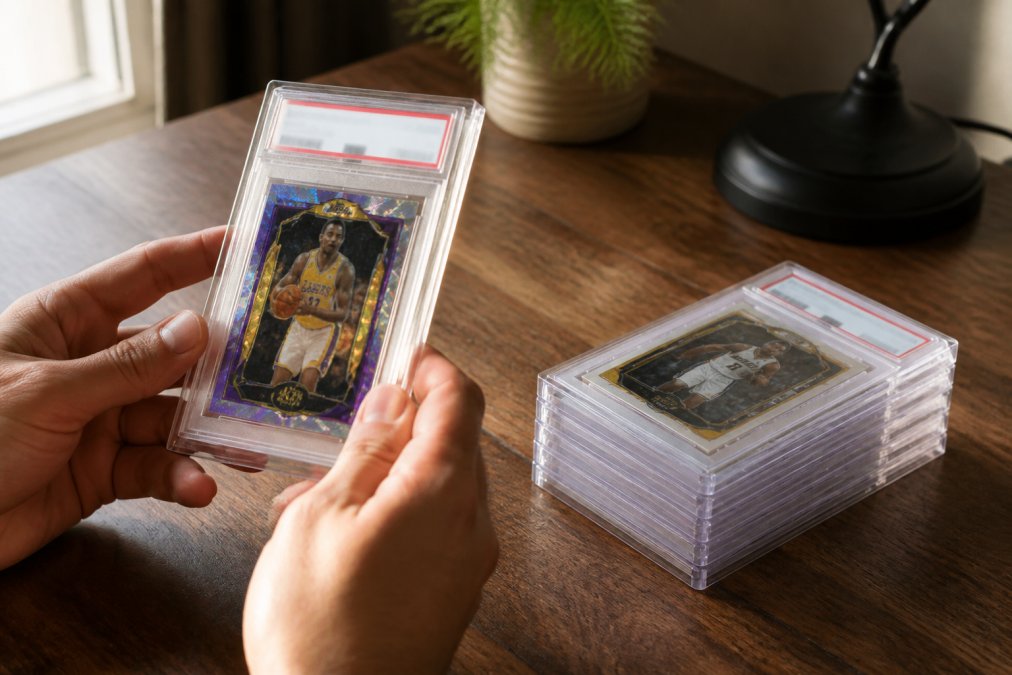
UV Protection and Light Resistance
UV protection is the most important spec most buyers ignore. Sunlight and prolonged indoor lighting emit ultraviolet radiation that breaks down a card's inks and coatings, fading colors permanently.
Look for cases rated for meaningful UV blocking, not vague "UV-resistant" claims. Crystal-clear materials with embedded UV inhibitors protect the card without dulling its appearance. A case that blocks light but yellows over time defeats the purpose.
Impact Resistance and Material Quality
Impact-resistant construction separates display pieces from real protection. Drop a slab in a thin acrylic shell and you risk cracked corners or a damaged label.
The best materials are TPU for shock absorption and polycarbonate for rigidity. Aluminum frames add strength but weigh and cost more. For most collectors, a polycarbonate or TPU shell with foam padding strikes the right balance between protection and portability.
UV Protection for Graded Cards: What the Numbers Actually Mean
A percentage means nothing without context. UV protection for graded cards is expressed as the share of ultraviolet radiation a material blocks, and the gap between ratings is wider than it looks.
A case rated at 95% UV protection blocks most fading radiation; a 50% case lets through ten times more UV. Over years of display, that shows up as faded ink on a card you can no longer sell at full grade value.
Three practical rules apply here:
- Prioritize UV rating over cosmetic design when cards sit in direct or indirect sunlight
- Rotate displayed cards periodically to spread light exposure evenly
- Store high-value slabs in a dark, climate-stable space when not on display
For context on how light exposure affects collectibles over time, the Library of Congress preservation guidance on light damage explains why even brief daily exposure accumulates. Value preservation is a long game, and UV resistance is the cheapest insurance you can buy.
How to Store PSA Cards Long Term Without Risking Condition
"Keep it dark and dry" is correct but incomplete. Over ten to thirty years, the threats to a graded card are slow chemical and physical processes no case can stop, only slow down. Understanding them separates a collection that holds its grade from one that quietly degrades.
The Four Slow Failure Modes
Plasticizer migration. The slab contains plasticizers that keep it flexible and clear. Over years they migrate to the surface, clouding or yellowing it. Heat accelerates this: a slab in an attic swinging between 60°F and 110°F clouds years before one kept at a stable 68°F.
Label adhesive failure. Adhesives are sensitive to heat and humidity cycling. Repeated expansion and contraction can lift or wrinkle a label corner, a cosmetic defect that complicates resale even though the card is untouched.
Humidity cycling. Paper and cardboard absorb and release moisture as humidity changes. A card cycling between 30% and 70% RH will warp, stressing the slab's internal fit. A stable 40-50% RH is the common target among preservation-minded collectors.
Surface contact. Every time a slab slides inside a loose case, the card and slab's inner face pick up micro-abrasions. Over hundreds of handling events, that reads as lower condition even when the grade has not changed.
A Storage Routine That Addresses All Four
- Keep slabs in acid-free, archival-quality sleeves or cases so no reactive chemistry touches the card or label.
- Store in a stable, dark environment away from windows, exterior walls, and vents. Interior closet shelves beat garages and attics.
- Use foam padding or a precision fit interior so the slab cannot shift during handling or transport.
- Control humidity with a hygrometer and, if needed, a rechargeable desiccant pack. Swap or recharge it on a schedule.
- Inspect cases every few months for scratches, clouding, or seal failure, and rotate displayed cards back into dark storage.
- Keep a written inventory with grades, storage locations, and inspection dates so problems are caught early.
Compatibility: The Spec Most Buyers Never Check
A case that does not fit your slab is a rattle chamber. Slab dimensions are not universal across grading companies, and thicker relic and patch cards can sit in a different slab generation than a standard base card. Before buying, confirm three things:
- Which grading companies and slab generations the case is rated for
- The interior cavity dimensions, not just the exterior footprint
- Whether the case accommodates thick slabs or only standard thickness
If a product page is vague about compatibility, treat that as a red flag. A precision fit is the most important spec after UV rating, because it prevents the micro-scratch damage that accumulates invisibly over years.
For context on how light and environmental exposure affect paper-based collections over time, the Library of Congress preservation guidance on environmental damage is a useful reference. Value preservation is a long game, and the collectors who win it are the ones who control the environment, not just the case.
PSA Slab Storage Box vs. Display Case: Which Fits Your Collection?
Choosing between a PSA slab storage box and a display case depends on collection size and how often you want to see your cards. Most serious collectors need both.
A slab storage box is built for volume. Boxes with stackable compartments and interior lining hold dozens of PSA graded cards securely, protect against dust and light, and tuck into a closet or safe, right for the bulk of a portfolio that rarely comes out.
A display case is built for presentation. Crystal-clear construction with UV blocking shows off a favorite card while guarding it.
| Storage Option | Best For | Protection Level | Display Value |
|---|---|---|---|
| Slab storage box | Large collections, long-term holds | High (light + dust sealed) | Low |
| Display case | Showcase pieces, small rotations | High (with UV rating) | High |
| Single-slab protector | Travel, handling, trading | Medium to high | Medium |
| Bulk storage tray | Sorting and inventory | Low to medium | None |
Magnetic Seal vs. Snap-Fit: Which Closure Protects Better?
| Closure Type | Hold Strength | Cycle Life | Weight | Best Use |
|---|---|---|---|---|
| Magnetic seal | High, even | Very high | Heavier | Display, travel, frequent handling |
| Snap-fit | Medium | Degrades with use | Lighter | Long-term box storage, bulk |
| Friction/sleeve | Low | High | Lightest | Temporary transport only |
The Magnet Question, Answered Properly
Security and Theft Deterrence
Compatibility and Security: What Most Guides Skip
Frequently Asked Questions
What card protector does PSA recommend for graded slabs?
PSA does not endorse a specific brand, but the company recommends cases that fully enclose the slab without adding pressure to the edges. Look for archival-quality materials, acid-free interior lining, and a precision fit that prevents movement. UV protection matters if you display your cards, since prolonged light exposure fades autographs and color. A case with a magnetic seal or secure snap-fit keeps dust and moisture out while letting you handle the slab safely.
What is the best protective case for PSA slabs to prevent UV damage?
The best case for UV protection blocks at least 95% of ultraviolet light. PrismGuard Pro cases are engineered to that threshold, which reduces fading during display and long-term storage. Check whether the manufacturer publishes third-party test results rather than just claiming UV resistance. Crystal-clear polycarbonate or acrylic with a UV-inhibiting coating outperforms standard plastic sleeves, which offer almost no UV defense. If your cards sit on a shelf near a window, UV protection is not optional.
Are hard plastic cases better than soft sleeves for PSA cards?
Hard plastic cases win for graded slabs. Soft sleeves are designed for raw cards and do not accommodate the thickness of a PSA slab, leaving edges exposed to scratches and corner dings. A hardshell case with foam padding or a precision-fit interior absorbs impact if you drop the card. Soft sleeves also offer zero UV protection and no moisture resistance. For any card worth grading, a hard case is the right choice for storage and display.
How do I store PSA-graded cards long term without risking condition?
Store slabs upright in a cool, dry place away from direct sunlight. Use acid-free, archival-quality cases with UV protection and a secure closure. Avoid attics and basements where humidity swings cause moisture damage. A PSA slab storage box works for bulk collections, while individual display cases suit cards you want visible. Check cases annually for dust buildup or seal degradation. Consistent temperature and low humidity preserve both the card and the grading label over decades.
Graded card protection is not a place to cut corners, because a single faded or scratched slab can erase the value of the card inside it. PrismGuard Pro builds cases around the details that matter most: 95% UV protection, impact-resistant materials, a precision fit, and a secure magnetic closure that keeps slabs stable during display and storage. If you are protecting a serious collection, get started with PrismGuard Pro and give your graded cards the defense their condition deserves.