

Table of Contents
- Do Magnetic Card Cases Damage Trading Cards? The Short Answer
- Card Warping and Bowing: The Pressure Point Problem
- Do Magnetic Cases Need Penny Sleeves? Inner Sleeve Compatibility Explained
- Magnetic Card Case vs Toploader: Which Protects Better?
- UV Protection for Trading Cards: Why Material Safety Matters
- Edge and Corner Damage: Proper Sizing for Card Thickness (Pt Ratings)
- Visual Inspection Checklist for Cards in Magnetic Cases
- Frequently Asked Questions
Last Updated: October 4, 2026
Do Magnetic Card Cases Damage Trading Cards? The Short Answer
No, magnetic card cases do not damage trading cards when matched correctly to card thickness and used with a protective inner sleeve.
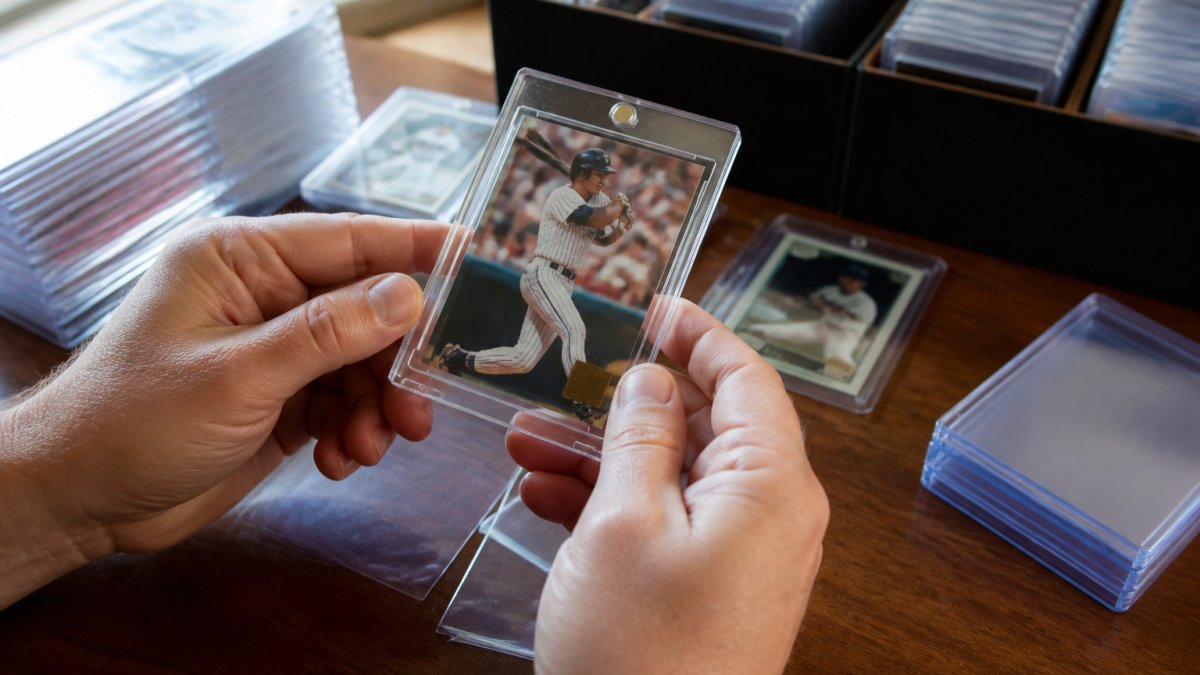
A magnetic case is a rigid housing, and that rigidity only protects a card when the card cannot shift inside it.
(https://www.loc.gov/preservation/about/faqs/paper.html) makes the same point about handling: clean, covered surfaces prevent the abrasion that ruins value.Micro-Abrasions and Card Movement: What Causes Them
Micro-abrasions are tiny scratches that dull a card's gloss and soften its edges over time. They build up gradually, so collectors often miss them until grading reveals a lower surface score than expected.
Three conditions create them:
- Loose fit. A case sized for a thicker card lets a thin card rattle.
- Bare surfaces. An unsleeved card drags directly against plastic or acrylic.
- Repeated handling. Every time you open the case, the card can shift.
A common mistake is assuming a snug-looking case means a secure card. Snug at the edges does not mean secure at the surface.
Card Warping and Bowing: The Pressure Point Problem
Card warping in a magnetic case is not caused by the magnets themselves. It comes from three forces: the card's internal moisture content, the case's rigid flat panels, and the point-loaded pressure from the magnets.
Why Cards Bow in the First Place
Card stock is a layered paper product. The front coating (gloss, foil, or holo film) and the back coating absorb and release moisture at different rates.
A magnetic case does not cause this, but it can lock the bow in place. If you case an already-bowed card, the rigid panels hold that curve and the magnets apply constant pressure that prevents the stock from relaxing flat.
The Magnet Point-Loading Problem
Most one-touch cases use four magnets, one near each corner, so clamping force concentrates at four points rather than across the card face.
This is why cushion strips matter. A foam or felt strip running the full length of the case interior converts four point loads into a distributed load. The pressure spreads across the card face instead of concentrating at the corners.
How to Safely Flatten a Bowed Card Before Casing
If a card is already bowed, do not force it flat in a magnetic case. That traps the stress. Instead:
- Remove the card from any case or toploader.
- Place it in a fresh penny sleeve to protect the surface.
- Sandwich it between two clean, flat, rigid boards, acid-free cardstock or clean glass works. Avoid anything with ink or adhesive.
- Apply even, light weight, a stack of books is enough. Do not clamp.
- Let it rest in a stable, room-temperature, moderate-humidity space for 3 to 7 days.
- Check daily. If the bow is relaxing, continue. If it is not, the card may have a permanent set and should not be forced.
Cards in dry climates bow toward the coated side; humid climates bow the opposite way. Matching storage to the card's equilibrium beats any flattening technique.
Matching the Case to the Card's Point Rating
A 35pt case should hold a 35pt card; a 55pt case should hold a 55pt card. There is no universal fit. If you feel resistance when closing, the card is too thick. If it slides when you tilt the case, it is too thin.
Storing a card in a case that is too thin for its thickness is the single biggest cause of bowing. The magnets still close, so nothing looks wrong, but the card is under constant bending force. Over months, that becomes permanent.
Store cases flat, not leaning. A case propped against a shelf edge adds a second pressure point along one edge, which is a common cause of asymmetric bowing that collectors mistake for manufacturing defects.
When Bowing Is Not the Case's Fault
Some cards arrive from the manufacturer already bowed. Foil and holo cards are especially prone because the foil layer and paper backing expand at different rates. If a card bows within days of being pulled from a pack and cased, it was already under stress. Flatten it before casing rather than blaming the case.
Do Magnetic Cases Need Penny Sleeves? Inner Sleeve Compatibility Explained
Yes, magnetic card cases need penny sleeves, and this is the step most collectors skip. A penny sleeve is a thin, soft plastic inner sleeve between the card and the case.
Not every sleeve fits every case, so test yours before committing a valuable card:
- Slide the sleeved card into the case with the case open.
- Close it gently. There should be no resistance and no visible bulge.
- Turn the case upside down and shake lightly. The card should not move.
A perfect-fit sleeve works for most standard cases. For a chrome card or one with a holographic surface, a soft sleeve matters even more because those finishes show micro-abrasions faster than matte stock.
Magnetic Card Case vs Toploader: Which Protects Better?
A magnetic card case protects better for display and long-term storage, while a toploader protects better for shipping and bulk handling. The right choice depends on what you are doing with the card, not which product is "better" in absolute terms.
| Feature | Magnetic Card Case | Toploader |
|---|---|---|
| Best for | Display and long-term storage | Shipping and bulk sorting |
| Card access | Reopenable magnetic closure | One-time insertion, hard to remove |
| Pressure on card | Even, with cushion strips | Minimal, loose fit |
| Surface protection | High with inner sleeve | Moderate |
| Resale appeal | Professional presentation | Utility only |
| Reusability | High | Low |
For a card you plan to display or hold as an investment, a magnetic case wins. For a card you are mailing tomorrow, a toploader plus a team bag is the safer, cheaper option.
UV Protection for Trading Cards: Why Material Safety Matters
UV protection for trading cards is about slowing fade, not stopping it. Ultraviolet light breaks down the inks and coatings on a card's surface, and no consumer case eliminates that entirely. A good case reduces exposure during display.
PrismGuard Pro Magnetic One-Touch Case →
But UV is only half the material-safety story. The other half is what the case releases over time. A case that blocks 99% of UV but off-gasses chlorine compounds will still ruin a card, which is why material chemistry matters as much as light transmission.
UV Blocking vs. UV Stabilizing: What the Labels Actually Mean
A case that blocks UV absorbs or reflects ultraviolet wavelengths before they reach the card. A case that is UV stabilized has additives that prevent the plastic itself from degrading under UV.
When you evaluate a case, look for language specifying the percentage of UV transmission blocked. "UV protected" without a number is marketing, not a specification. Most quality acrylic and polycarbonate cases block somewhere between 90% and 99% of UV-A and UV-B, depending on formulation and thickness.
Acid-Free and PVC-Free: The Chemistry That Matters
Acid-free means the material will not release corrosive compounds that yellow or stain card stock over time.
PVC-free means the plastic contains no polyvinyl chloride. PVC contains plasticizers, phthalates, that migrate out over time and can bond to card surfaces, leaving a greasy film nearly impossible to remove without damaging the card.
The safe alternatives are polyethylene (PE), polyethylene terephthalate (PET), and polypropylene (PP). These are the plastics used in archival-grade sleeves and cases.
How to Test a Case for Material Safety
You cannot always trust a label. Here is a simple field test:
- Smell the case. A strong plastic or chemical odor is a warning sign. Archival-grade plastics have little to no smell.
- Check for clarity. PVC tends to be slightly cloudy or have a blue tint. PET and acrylic are clearer.
- Look for a recycling code. PET is code 1, PP is code 5. PVC is code 3. Avoid code 3.
- Check the edges. Burrs or sharp edges can scratch a card during insertion. Run a finger along the interior edge before casing.
Store your display shelf away from windows and skylights, even with UV-protected cases. The reduction is measured against direct exposure, and indirect daylight adds up over years. Rotating which cards are on display spreads the exposure across your collection.
The Long-Term Storage Consideration
Material safety is not a one-time check. Plasticizers and acidic compounds migrate slowly, so a case that is safe today can become a problem in five years if the plastic is low-grade.
If you see any of those signs, remove the card immediately, replace the sleeve, and consider switching to a case with a documented material specification. A replacement case costs far less than a ruined card.
Edge and Corner Damage: Proper Sizing for Card Thickness (Pt Ratings)
Edge and corner damage comes from a mismatch between card thickness and case size. The pt rating prevents it. A point equals 1/1000 of an inch, so a 35pt card is 0.035 inches thick.
Match your case to the rating:
- Standard cards: Most modern trading cards sit around 20pt to 35pt.
- Thicker stock: Premium and foil-heavy cards run higher.
- Graded slabs: These are not measured in pt. They need a case built for the specific slab, which is why PrismGuard Pro makes separate cases for PSA, BGS, and CGC holders.
Corner wear happens when a card can move laterally inside a case. The American Library Association guidance on preservation echoes the principle: stable, well-fitted housing prevents the physical damage that loose storage causes.

Visual Inspection Checklist for Cards in Magnetic Cases
Run this checklist every few months. It takes two minutes and catches problems before they become permanent.
- Lay the case on a flat surface and check for any gap under the card
- Look at the card's surface under a direct light for new micro-abrasions
- Check all four corners for wear or rounding
If you find bowing, remove the card, let it rest flat in a sleeve for a few days, and switch to a case that matches its thickness.
For graded cards, choose the case that matches your holder. The PrismGuard Pro PSA Magnetic Slab Case and the BGS Magnetic Slab Case are built for standard slabs, with clear panels, an aluminum frame, and a magnetic closure for display, storage, and transport.

For raw cards in one-touch holders, the PrismGuard Pro Magnetic One-Touch Case fits a 35pt holder measuring 110 mm high by 73 mm wide by 7 mm thick.
Frequently Asked Questions
Will magnets in card cases damage credit cards or trading cards?
The magnets used in magnetic card cases are weak and positioned to hold the case closed, not to affect the card inside. Credit cards and trading cards store data in magnetic stripes or chips that require much stronger magnetic fields to disrupt. The real risk to trading cards is physical, not magnetic: surface scratching from card movement, pressure points causing warping, and UV fading. Using a properly sized magnetic card case with an acid-free inner sleeve addresses these physical risks without any magnetic interference.
Do magnetic cases need penny sleeves inside?
Yes, using a penny sleeve inside a magnetic case adds a layer of protection against surface scratching and friction damage. A perfect-fit sleeve keeps the card from shifting when the case is handled, reducing micro-abrasions on the surface. For chrome, foil, and holographic cards, a sleeve is especially important because these surfaces show scratches easily. Make sure the sleeve is acid-free and PVC-free to avoid chemical reactions that can damage card stock over time.
Are magnetic card cases better than toploaders for long-term storage?
Magnetic card cases offer better display and UV protection than standard toploaders. A magnetic case with a recessed cavity and secure closure keeps the card flat and reduces corner wear during handling. Toploaders are cheaper and good for shipping, but they offer no UV protection and can allow more card movement. For high-value cards you plan to display or store long-term, a magnetic case with 95% UV-blocking panels and a precision fit is the stronger choice.
How do I know if my magnetic card case is causing card warping?
Check your card every few months by removing it from the case and laying it on a flat surface. If you see bowing or a curve, the case may be applying uneven pressure. This often happens when the card is too thick for the case or when the foam insert is missing. Use a case sized to your card's pt rating, always use the included cushion strips, and store cases flat rather than upright to prevent pressure points from causing warping over time.
The real challenge with magnetic card cases is not whether they work. It is whether the one you buy actually fits your card, your sleeve, and your holder. A case that is even slightly off turns protection into pressure. PrismGuard Pro builds cases around precision fit, impact-resistant materials, and a secure magnetic closure, with 95% UV protection and cushion strips included to keep pressure even. Get started with PrismGuard Pro and display your collection knowing the housing is doing its job.